Chapter 1: The 5-Minute Rule Is Real (and Most Agents Cannot Meet It)

The research is unambiguous. A 2007 study by MIT and InsideSales.com tracked 15,000 leads and over 100,000 contact attempts across six companies. The finding: a lead contacted within 5 minutes is 21 times more likely to qualify than a lead contacted at 30 minutes, and 100 times more likely to make contact than a lead contacted after 30 minutes. A separate Harvard Business Review audit of 2,241 US companies found that companies responding within 1 hour were 7 times more likely to qualify a lead than those responding later. The average response time in that study was 42 hours. Twenty-three percent of companies never responded at all.
Real estate-specific data is consistent with the broader pattern. The WAV Group found average agent response times exceeding 15 hours in markets they studied. NAR's research shows that 78% of buyers ultimately work with the first agent they speak with, and 70% interview only one agent before deciding. The first-mover advantage is not marginal. It is determinative in a large percentage of transactions.
The structural problem is timing. According to NAR and Zillow, 62% of real estate inquiries are submitted outside business hours, on evenings and weekends, when buyers have time to browse listings and reach out. That is exactly when most agents are not monitoring their phones, not responding within 5 minutes, and not even seeing the inquiry until the next morning. By then, the buyer has often already spoken to an agent who did respond, and the first-mover advantage is gone.
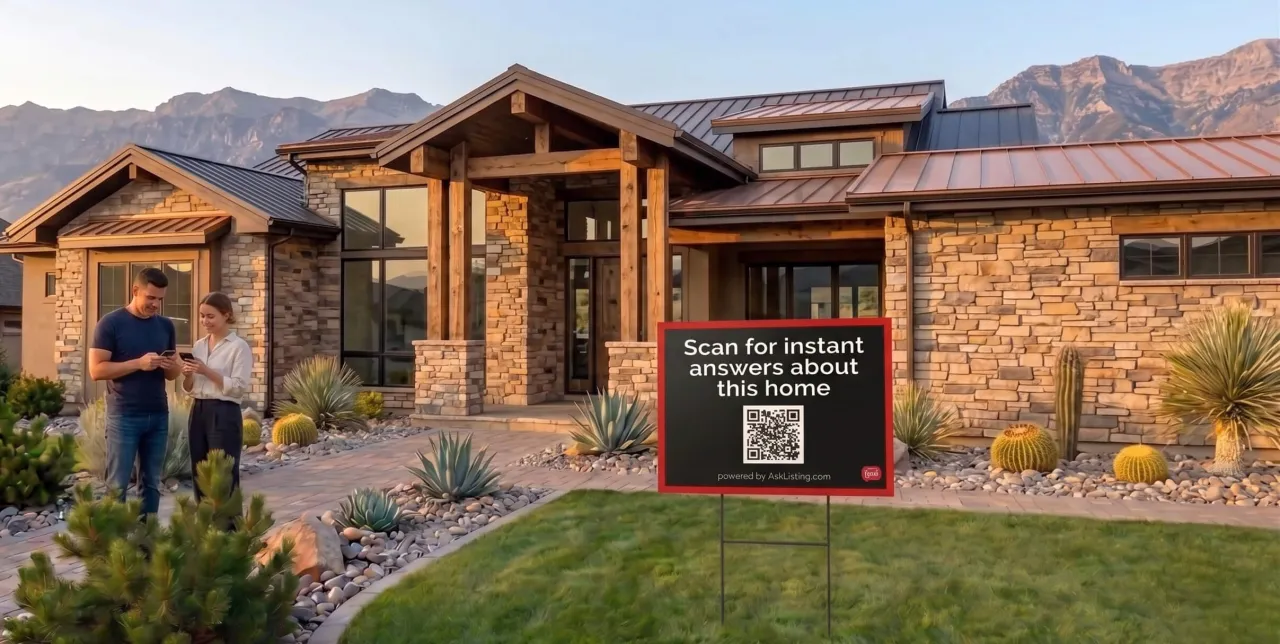
This is not a criticism of agents. Human response at 9pm on a Saturday is not a realistic expectation for a sustainable practice. It is an architecture problem. The 5-minute rule is the requirement. Human agents cannot reliably meet it outside business hours. That gap is the primary driver of AI-powered listing response: the buyer texts in from a QR code, the AI responds in under 60 seconds with grounded answers about the specific property, and the agent receives a full conversation summary in the morning. The 5-minute rule is met. The agent's response, when it comes, lands in a conversation that is already warm.
Chapter 2: What Buyers Actually Do After They Inquire on a Listing
Most real estate follow-up guides treat the buyer as a passive entity waiting for the agent to call. The actual buyer behavior is more active and more competitive than that framing suggests.
A buyer browsing Zillow or Redfin on a Tuesday evening is not looking at one listing. They are looking at eight. When they find listings they like, the platform makes it easy to fire off an inquiry in seconds: tap "Contact Agent," submit the pre-filled form, move to the next listing. By the end of a 45-minute browsing session, a serious buyer may have contacted five agents on five different properties. They did not sit with each inquiry and carefully consider it. They sent them all and went to sleep.
The agent who calls back the next morning at 9am is not the only call that buyer receives. They are one of five callbacks happening in the same hour. The buyer is now evaluating agents in real time, and the evaluation criteria are speed, specificity, and whether the agent demonstrates they know which listing the buyer was asking about. The agent who says "I see you inquired about 142 Elmwood, and I noticed you were asking about the garage situation" is playing a different game than the agent who says "Hi, I'm following up on your inquiry."
The Zillow 2025 Consumer Housing Trends Report is worth citing here: a majority of buyers who worked with an agent preferred text and messenger app communication over phone calls. Only a third preferred phone as their primary channel. Email was preferred by even fewer. Buyers have a channel preference, and it is SMS. The agents who align their follow-up system with that preference do not just respond faster. They respond in the medium the buyer already chose.
Chapter 3: The Simultaneous Multi-Inquiry Problem
Real estate follow-up guides almost universally treat each lead as an isolated relationship: one buyer, one inquiry, one follow-up sequence. This frame misses the most important competitive dynamic in the modern buyer journey. A buyer on a major portal can contact multiple listing agents in under a minute. They do not need to make separate decisions for each. The platform's "contact agent" button is frictionless by design.
The practical consequence is that the follow-up race is simultaneous, not sequential. Five agents get the same buyer's inquiry at the same time. The race is not "be faster than you were last month." The race is "be faster than the other four agents who just got the same notification." In that context, a 5-minute response is not impressive. It is the entry requirement for staying in the race.
Here is what the buyer's next 24 hours actually look like when five agents have their inquiry:
The QR listing agent did not win because they were fastest in absolute terms. They won because the AI was fastest at 9pm when it mattered, and the agent's Wednesday morning text referenced the conversation that already existed. Every other agent made the buyer start over from a cold introduction. The QR listing agent continued a conversation that was already 12 hours old.
Chapter 4: The Follow-Up Cadence That Converts
The right follow-up cadence has two distinct phases. Research from Velocify and the National Sales Executives Association consistently shows that 80% of sales require 5 or more follow-up contacts, and 44% of salespeople give up after one. For real estate, where the transaction timeline can span weeks or months, the cadence needs to be front-loaded and then sustained at lower frequency with higher relevance.
The 30-to-45 day re-engagement is the most underused window in real estate follow-up. Inactive leads show response rates around 22% when contacted with genuinely relevant new inventory. A buyer who went silent on a $600k listing in March is a warm prospect when a $575k listing with the same bedroom count hits the market in April. The text that works is specific to what they were originally looking at, not a generic "checking in" message.
Chapter 5: Text Scripts That Actually Work in 2026
The scripts that convert share a consistent structure: they are short, they reference the specific property or prior conversation, and they ask for one specific response. Scripts that open with agent biography, explain the value of working with a professional, or pitch the local market perform significantly worse. The buyer already has context. The script's job is to move the conversation one step forward, not to re-sell them on real estate.
Hi [name], this is [agent] from [brokerage]. You just inquired about [address]. I'm available right now. Would you prefer a quick call or should I text you the key details?
The "call or text" choice gives the buyer agency. Buyers who choose text are self-selecting into a channel they are comfortable with. Buyers who choose a call are often further along in their decision.
Hi [name], [agent] again on [address]. I have a showing slot open this week if you want to see it in person. No pressure if the timing is not right. Just wanted to make sure you had the option.
Offering a specific next step (showing slot) converts better than an open-ended "still interested?" The buyer does not have to generate the next action. They just have to say yes or no.
Hope the showing at [address] went well today. Any questions that came up while you were there? Happy to get answers or talk through what you thought.
The same-evening post-showing text is the highest-converting touchpoint in the relationship. The buyer's impressions are fresh. Their objections are specific. This window closes by the next morning.
Heads up on [address]: another offer came in. Wanted to let you know before it moves. If you want to talk through your options, I'm available now. Call or text me back.
Real urgency converts. Manufactured urgency does not. Only use this when there is actually a competing offer. The word "now" in the last line creates a specific time anchor that drives response.
Hi [name], [agent] here. A listing just hit that matches what you were looking at back in [month]: [brief match description, e.g., "4 bed, garage, similar price"]. Want me to send you the details?
Connecting new inventory to their prior search signals that you remembered what they were looking for. This is the difference between a useful alert and a mass market update.
For the complete set of scripts covering inbound flows, AI handoff messages, and carrier-compliant variation sets, see our guide to real estate text message scripts.
Chapter 6: The Multi-Channel Problem Nobody Talks About
Every real estate follow-up guide describes multi-channel follow-up as a channel selection problem: use text for initial contact, call for deeper conversations, email for long-term nurture. This framing treats SMS, voice, and web chat as three separate tools in a sequence. It completely misses the actual problem: when a buyer switches channels, most agent systems restart the conversation from scratch.
Here is what that looks like from the buyer's perspective. A buyer scans a QR code on a yard sign at 9pm Saturday and texts in. The AI answers their question about the HOA, confirms the listing price, and asks about their timeline. The buyer replies that they are flexible and have a pre-approval letter. The AI notes the showing interest and alerts the agent. On Monday morning, the agent calls the buyer. The agent has not seen the Saturday thread. Their opening line is: "Hi, I'm calling about your inquiry. Can you tell me which property you were interested in and what you're looking for?"
The buyer spent eight minutes Saturday night giving the AI exactly that information. They now have to repeat it. What that repetition signals to the buyer is not just inconvenience. It signals that the agent was not paying attention. That the Saturday conversation did not matter. That each channel is a separate and unconnected experience. That this agent's system is not designed around the buyer's experience. The buyer may not consciously identify all of this. But they notice. And their ranking of this agent drops.
This is the multi-channel problem: not which channels to use, but whether the conversation persists across them. The agents and platforms that solve this problem do not just respond faster. They respond as a continuous relationship, not as a series of fresh introductions.
AskListing responds to inbound buyer texts in under 60 seconds, around the clock, and keeps the full conversation history so the agent picks up exactly where the AI left off. Try it free on your next listing →
Chapter 7: First Responder with Context Beats First Responder Alone
The 5-minute rule is a speed rule. The insight that most follow-up guides miss is that speed and context are not the same variable, and context often matters more than a 60-minute difference in response time.
An agent who responds at 9pm Saturday via AI, and then follows up Monday morning with full knowledge of that conversation, is competing against agents who respond at 8am Monday with zero context. The Saturday-night AI response already won the first-contact race. Monday's agent text wins the context race. Together, they are not two separate follow-ups. They are one continuous conversation that started 36 hours ago and has been running since.
At AskListing, we built this around a single principle: one conversation object per buyer per listing, accessible from any channel. When a buyer texts in from a sign, the conversation starts. When that same buyer calls two days later, the voice system already knows who they are and what they discussed. When the agent reaches out Monday morning, they see the full transcript. The buyer is not a new contact. They are a conversation that has already been running, and the agent is joining it, not starting it.
The competitive advantage this creates is not primarily a speed advantage. It is a quality-of-relationship advantage. Buyers buy from agents who make them feel known. Specificity signals attention. Attention signals care. Care signals the kind of professional relationship that earns referrals after the close. The transaction that starts with a QR code scan at 9pm and ends 60 days later at a closing table does not feel like a smooth, attentive experience because the agent was fast. It feels that way because the conversation never reset. For more on how the AI engine that powers this works, see our real estate chatbot guide. And if you are wondering whether automating this follow-up work means the agent becomes optional, see our take on whether AI actually replaces real estate agents: it does not, it just makes sure the follow-up never drops.
The practical checklist for agents who want to build toward this model:
- Audit your current system for conversation resets. When a buyer switches from SMS to email to call, does your system know? If not, every channel switch is a restart.
- Ensure your AI response includes a summary mechanism. The agent should receive a conversation summary, not just a notification, when a lead is escalated. A summary that includes the buyer's questions, answers, and stated timeline removes the most common cause of conversation restarts.
- Train your opening line for the second contact. The most valuable sentence in any follow-up call or text is a reference to the prior conversation. "I saw you were asking about the parking situation at [address]" is worth more than any script opener that starts from scratch.
- Instrument your after-hours coverage. If 62% of inquiries come in evenings and weekends and your response system is human-only, you are structurally losing more than half the first-mover race before business hours begin.