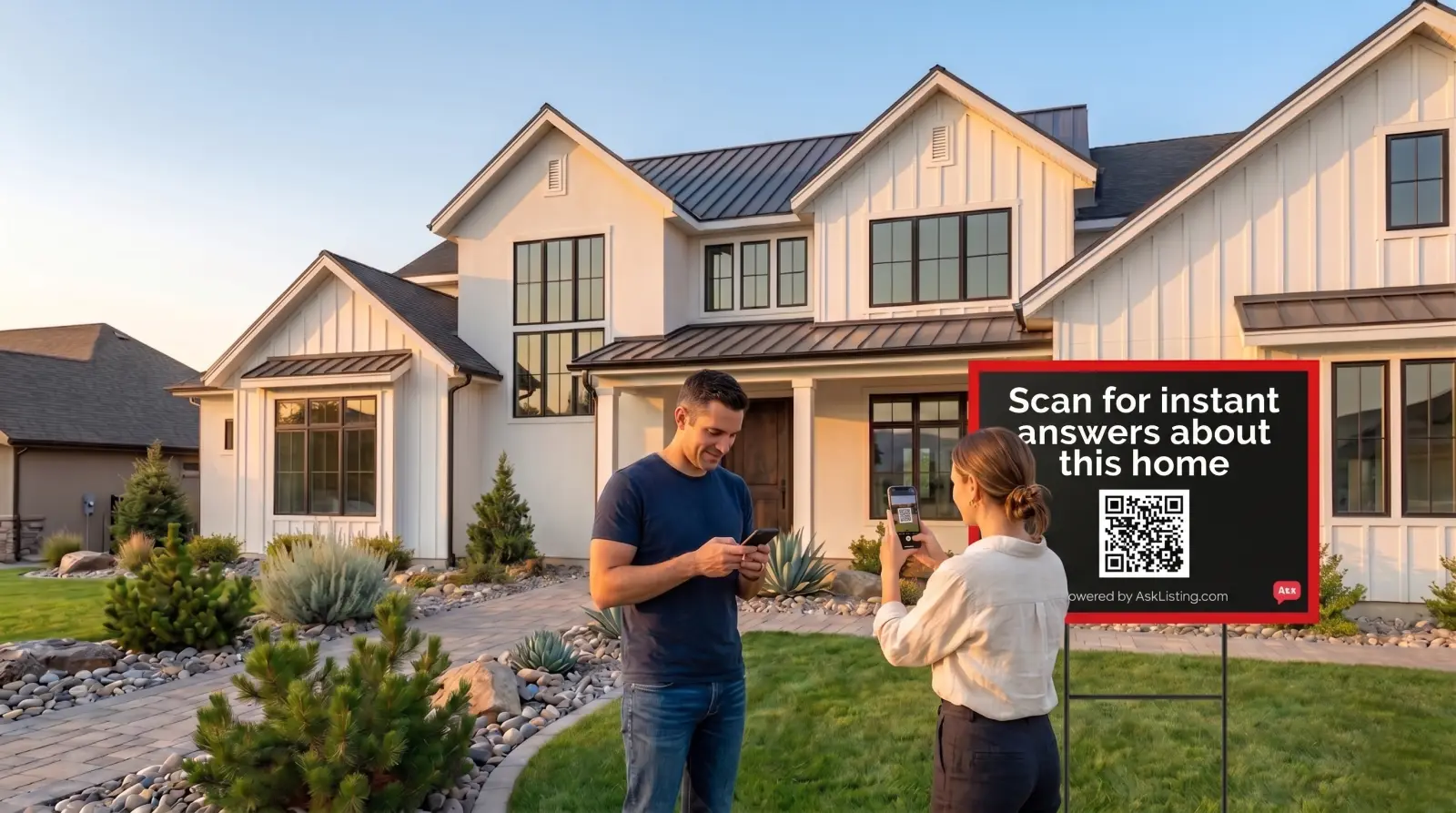
AskListing is AI SMS marketing for real estate: it answers buyer texts instantly, qualifies leads, and books showings, fully 10DLC compliant.
Chapter 1: Why SMS Outperforms Every Other Channel for Real Estate
Most people hear "SMS marketing for real estate" and picture blasting a contact list with promo texts. The version that actually moves listings is the opposite: inbound. A buyer is standing in front of your sign, scans the QR code or texts the keyword, and a conversation starts on their terms. That is the moment this guide is built around, turning a sign scan into a qualified buyer lead, and it is where text messaging beats every other channel.
Real estate text message marketing is not just another channel for agents and realtors. It operates in a different category from email, social, or paid search, and the data makes the gap impossible to ignore. SMS carries a 98% open rate and an average read time of under three minutes. Email, by comparison, lands at 20-25% open rates and a 6% response rate on a good day, according to widely cited SMS and email industry benchmarks. That is not an incremental improvement. It is a structural difference in how the medium is consumed.
Think about where a text message arrives. It lands in the same thread as messages from the buyer's spouse, their parents, their close friends. The phone lights up and they read it. An email competes with newsletters, promotional blasts, calendar notifications, and work threads. Even when buyers intend to follow up on a listing, the email gets buried by the time they sit down at a computer. The text message does not wait. It is seen, and it is seen quickly.
The response rate tells the same story. Across industry SMS benchmarks, SMS responses average around 45%, compared to 6% for email. For a real estate agent running 10 to 20 active listings at once, that difference compounds into a meaningful revenue impact. More buyer responses mean more showings scheduled, more offers written, and more commission earned. The math is not complicated.
There is also a behavioral shift that has been accelerating since 2020, and it is particularly pronounced among buyers under 40. Many of these buyers simply will not call a number on a for-sale sign. They do not leave voicemails, they do not respond to calls from numbers they do not recognize, and they will not wait on hold. But they will send a text. If your listing does not offer a text option, you are invisible to a large and growing segment of the buyer market. Real estate text message marketing is the mechanism that captures those buyers before they move on to the next listing.
Chapter 2: Real Estate SMS Compliance: What You Need to Know
The Telephone Consumer Protection Act (TCPA) governs commercial text messaging in the United States, and it applies fully to real estate agents. The TCPA requires prior express written consent before you send any commercial SMS message to a consumer. The word "written" sounds formal, but in practice it includes digital records: a checkbox on a web form, a log entry showing that a buyer texted your keyword first, or a timestamp from a QR code landing page where consent language was displayed before capture. What it does not include is a phone number you collected at an open house on a paper sign-in sheet, unless that sheet contained explicit opt-in language for SMS marketing.
There are three practical methods for collecting valid consent. The first, and easiest, is the text-in keyword: the buyer texts a word like HOME or INFO to your number. Because the buyer initiated the conversation, that act itself constitutes express written consent under TCPA, though your first reply still has to carry the sender ID, description, and opt-out language covered below. The second method is a web form with a clearly labeled opt-in checkbox: "Yes, I consent to receive SMS messages about this listing from [Your Name], [Brokerage]. Reply STOP to unsubscribe." The checkbox must not be pre-checked. The third method is a QR code landing page where the consent language is visible before the buyer submits their number. All three approaches produce a defensible consent record if a compliance question ever arises.
Your first message has specific requirements regardless of how consent was collected. You must identify yourself by name and brokerage. You must explain what the buyer has signed up to receive, something like "You will receive listing updates and showing confirmations for [address]." And you must include opt-out instructions: "Reply STOP to unsubscribe." Skipping any of these elements does not void the consent you already have, but it creates risk if a buyer later disputes receiving messages they did not want. The first message is your paper trail, so include all three elements every time.
10DLC registration is a separate compliance layer that most agents do not know about until their messages start getting filtered as spam. US carriers require all commercial SMS senders using 10-digit long codes (the kind that look like a regular phone number) to register their business and campaign through the Campaign Registry. Without registration, carrier-side filtering increasingly treats your messages as spam, and delivery rates drop significantly. AskListing handles 10DLC registration automatically, so agents do not have to navigate the carrier registration process themselves. For a full breakdown of why registered campaigns still sometimes fail delivery and how to fix it, see our real estate 10DLC guide.
Finally: opt-out must be honored immediately and permanently. The moment a contact replies STOP, that number is removed from your send list. You do not send a final confirmation, you do not send a follow-up three months later to check if they changed their mind. One STOP reply ends the consent, full stop. TCPA violations carry statutory damages of $500 to $1,500 per message, and class-action suits in this space are not rare. The compliance requirements for real estate text message marketing are not complicated, but they must be followed precisely.
Chapter 3: Three Types of Real Estate SMS
Not all real estate SMS works the same way, and choosing the wrong type for the wrong situation creates both compliance risk and missed opportunity. There are three distinct models, each suited to a specific point in the buyer relationship.
Inbound keyword SMS is the foundation of real estate text message marketing for most agents. A buyer sees a keyword on your for-sale sign rider ("Text HOME to 555-1234") or your open house materials and sends the first message. Because the buyer initiated contact, you have express written consent from that moment. You also have their phone number, their interest in the specific listing, and the timestamp of their inquiry, all captured automatically. The compliance risk is zero because you never sent an unsolicited message. The lead quality is high because the buyer self-selected. Inbound keyword is the right choice for sign riders, open house table cards, flyer boxes, and listing descriptions. For a full breakdown of real estate sign types, sizes, and how QR codes turn a yard sign into a 24/7 lead capture point, see our real estate signs guide.
Consented follow-up SMS picks up a conversation that already has a consent record: the buyer texted in first, filled out a form with an opt-in checkbox, or scanned a QR page that displayed consent language. It is not a new outreach to a list. It is the next message in a thread with one specific buyer who already said yes. Used this way, it is effective for a price drop alert on a listing that buyer already asked about, a showing confirmation, or a post-showing check-in. The key is that the consent record must exist for that specific buyer before the message is sent.
AI-automated SMS combines the compliance safety of inbound with a speed advantage no human agent can match. When a buyer texts in, the AI responds in under 60 seconds, any hour of the day or night. It answers listing questions, gathers buyer information, and escalates hot leads to the agent with a summary of the conversation. This is where the stat beside this section becomes actionable: a 45% SMS response rate only matters if you respond before the buyer moves on. At 2 AM on a Sunday, the AI responds. A human agent does not.
Chapter 4: SMS Templates That Convert
Most agents overthink real estate SMS copy. The medium is inherently short, which means every word carries weight. A message that sounds like a marketing email ("We are pleased to offer you the opportunity to schedule a viewing of this exceptional property") reads as spam and gets ignored. The templates that convert are plain, specific, and contain exactly one action for the recipient to take.
Below are three production-ready templates for the most common real estate SMS scenarios. Each one follows the same structure: identify the property (so the buyer knows exactly what you are talking about), give them one piece of relevant information, and ask for or confirm one action. Nothing more. For a complete library including AI handoff scripts, variation sets for carrier filters, and fair housing deflections, see our real estate text message scripts guide.
Hi, thanks for your interest in [address]. I'm the AI assistant for this listing. What would you like to know: price, beds/baths, HOA, or something else? Reply anytime.
Your showing at [address] is confirmed for [day] at [time]. The agent will meet you at the front door. Reply CANCEL if your plans change.
Quick update on [address]: the price just dropped to $[price]. Still interested in a showing? Reply YES and I'll get you booked.
The new lead welcome template works because it does not pretend to be human and does not try to hide that an AI is involved. Buyers in 2026 expect AI responses, and they are not bothered by them as long as the response is fast and genuinely helpful. The menu format ("price, beds/baths, HOA, or something else?") gives the buyer an easy first response to send, which increases engagement rates and starts the qualifying conversation. Buyers who reply are more likely to be serious than those who never respond at all.
The price drop alert template converts because it is short, specific, and immediate. The buyer already expressed interest in this address. The message tells them exactly what changed, gives them the new number, and asks for exactly one thing. No preamble, no explanation of how excited you are about the property, no paragraph about the neighborhood. Just the update and a yes-or-no question. This format consistently outperforms longer messages in A/B tests across multiple real estate SMS platforms.
Chapter 5: How AI Turns SMS Into a Lead Qualification Machine
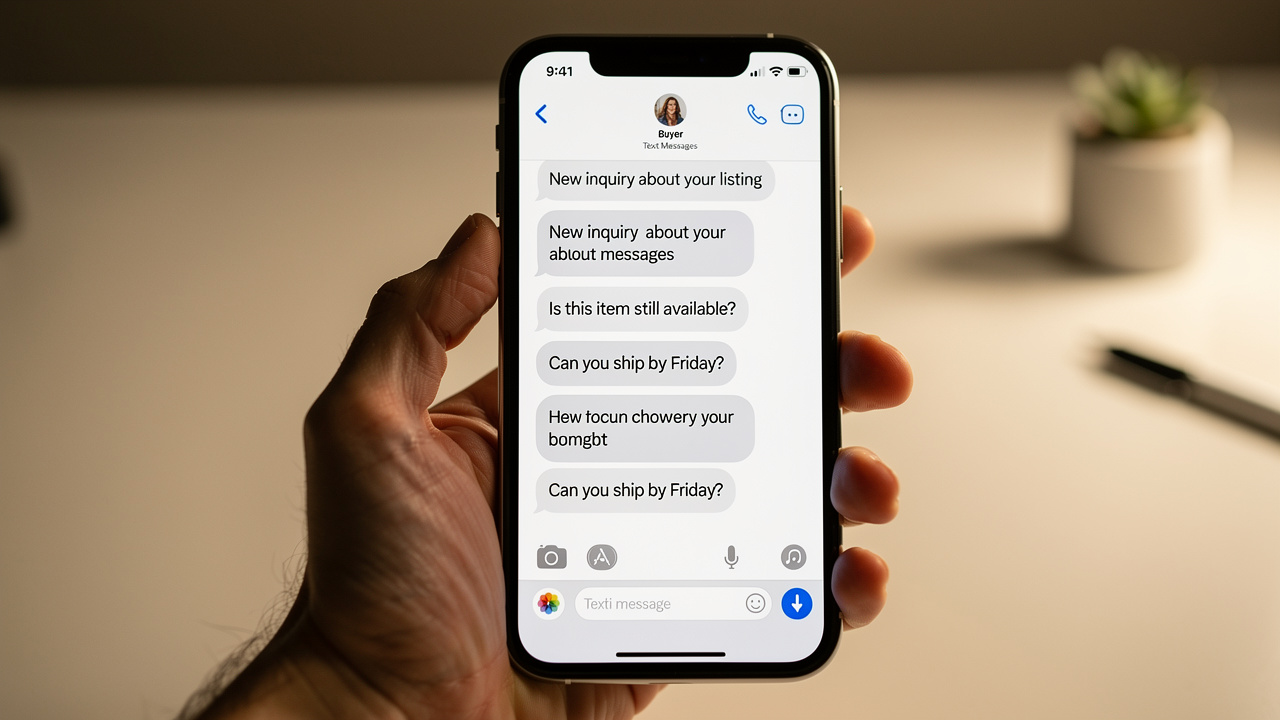
Qualification is where most agents lose leads they should have closed. A buyer texts in at 9 PM on a Tuesday. The agent sees it the next morning, sends a reply, and the buyer has already toured another listing and is in contract. The window between a buyer's first inquiry and their decision to move forward can be less than 24 hours in a competitive market. AI-automated SMS closes that window by qualifying the buyer immediately, without any agent involvement, at any hour.
The qualification flow works in three to five text exchanges. The buyer texts the keyword and the AI sends the welcome message (Template 1 above). The buyer replies with a question about the listing, the AI answers, then asks a qualifying question: "Are you currently working with a buyer's agent?" The buyer's response tells you a great deal. If they say yes, you know they have representation and likely a pre-approval. If they say no, the AI follows up: "Have you been pre-approved for a mortgage, or would that be a next step?" The conversation continues naturally, and the AI scores the lead based on the pattern of responses: response time, specificity of questions, answers to qualifying prompts. When the lead clears a threshold, the agent gets an alert with a full transcript of the conversation. By the time the agent responds, they already know who they are talking to, what the buyer wants, and how serious they are. For a deeper look at how AI handles buyer conversations from first contact through hand-off, see our real estate chatbot guide.
The practical result is that real estate text message marketing, when paired with AI qualification, compresses a process that used to take two to three days of back-and-forth phone calls into a 10-minute automated conversation. The agent spends their time on buyers who are already qualified, pre-approved, and ready to see a property. The AI handles the top of the funnel. The agent handles the close. For a broader guide to the full AI toolkit available to agents today, see our AI tools for real estate agents overview.
Chapter 6: What to Do After You Get the Text Lead
Even with AI handling qualification on the front end, the agent's response time after hand-off matters. When the AI escalates a hot lead, the agent should respond within 30 minutes during business hours. Studies on lead response time consistently show that the odds of connecting with a buyer drop dramatically after the first hour, and in a market where buyers are texting multiple listings simultaneously, 30 minutes is already slow. The fastest agents win a disproportionate share of appointments.
The content of the agent's follow-up text is just as important as the timing. Generic messages underperform. Something like "Hi, this is [Name], I see you were interested in a property" gives the buyer no reason to think you read their conversation with the AI. The right approach references the specific listing and the specific question or concern from the conversation transcript: "Hey, this is [Name] from [Brokerage], the listing agent for [address]. I saw you were asking about the HOA rules. Happy to jump on a quick call or set up a showing to walk through the details." That level of specificity signals that you are actually paying attention, which is rare enough in real estate that it creates a genuine competitive advantage.
After the agent makes contact, SMS remains the right channel for confirmation messages, logistics, and follow-up after a showing. A text confirming the time and address of a showing, a check-in the day after ("Did you have any questions after seeing [address] yesterday?"), and a gentle nudge when the buyer goes quiet ("The seller received another offer we wanted to flag. Happy to talk through your options if this is still on your radar.") all perform better as texts than as emails or phone calls. The buyer is already in the habit of responding to this number. Use that relationship through the entire transaction.
Chapter 7: Getting Started with Real Estate SMS Marketing
Setup is straightforward if you follow a logical sequence. Most agents overthink the technology and underthink the placement, which is the opposite of where the leverage actually is. A well-placed keyword on a high-traffic listing will generate more leads than a sophisticated automation system with no entry points for buyers to find it. For a broader look at inbound vs. outbound strategies across all real estate channels, see our real estate lead generation guide.
Start with the platform. You need an SMS tool that handles three things: 10DLC registration (so your messages are not filtered by carriers), inbound keyword support (so buyers can text a word to trigger the AI), and AI-powered responses (so leads are handled 24/7 without agent involvement). AskListing was built specifically for this workflow, including automatic 10DLC registration and a lead dashboard where you see every conversation in real time. See the full feature overview on the real estate chatbot product page. Once your platform is set up, choose a keyword for your listing (something simple and property-specific, like the street name or listing ID), set up the auto-response flow, and enable consent logging.
Then put the keyword everywhere. Add it to your for-sale sign rider ("Text ELMWOOD to 555-1234 for listing details"), your open house table cards, your MLS listing description, and any print materials you hand out at the property. Test the full flow yourself before the listing goes live: text the keyword from your own phone and confirm the AI responds correctly, the TCPA-required identity and opt-out language appears in the first message, and the lead shows up in your dashboard. For more ideas on placing SMS capture points at open houses, see our guide on open house lead capture. Fix any issues before buyers start texting, because a failed first response is a lost lead.
Chapter 8: SMS Marketing Beyond the Single-Family Listing
Everything above applies directly to an individual agent marketing one listing at a time, but the same inbound SMS model extends to a few adjacent audiences with their own compliance and volume considerations worth calling out.
Real estate investors running SMS marketing for real estate investors typically operate at higher volume than a single-listing agent: multiple properties, wholesale deals, and buyer lists that need to be re-engaged as new inventory comes in. The consent rules do not change (every message still needs a documented opt-in), but investors get more value from a persistent keyword tied to their brand rather than a per-listing keyword, so a repeat buyer can text the same word for every new deal.
Property management companies use SMS for a different job entirely: not lead capture, but resident communication. SMS for property management covers maintenance requests, rent reminders, and lease renewal notices, all of which still fall under TCPA if any message is promotional (a renewal offer, a referral incentive) rather than purely transactional. AI qualification is less relevant here than fast triage: routing an incoming "my heater is broken" text to the right maintenance vendor instead of a generic inbox.
HOAs and brokerages sending SMS to homeowners or agent rosters need the same consent and opt-out infrastructure as an individual agent, just at organizational scale. A brokerage rolling out text marketing for real estate agencies across a team should register one 10DLC campaign under the brokerage's business identity rather than each agent registering separately, since carriers evaluate sender reputation at the registered-business level.
The common thread across all three: the compliance foundation in Chapter 2 does not change based on who is sending the message or how many recipients are on the list. What changes is the message content and the reason a recipient consented in the first place.