Chapter 1: The Inbound Gap That Every Script Guide Misses
We have read the major real estate SMS script guides. The Close has 36 templates. Follow Up Boss has 31. TextRequest has 35. Emitrr has over 100. Every single one of them starts from the same assumption: the agent sends the first text. The scripts cover initial outreach, lead follow-up, open house invitations, price drop alerts, and past client check-ins. They are all agent-outbound in their frame.
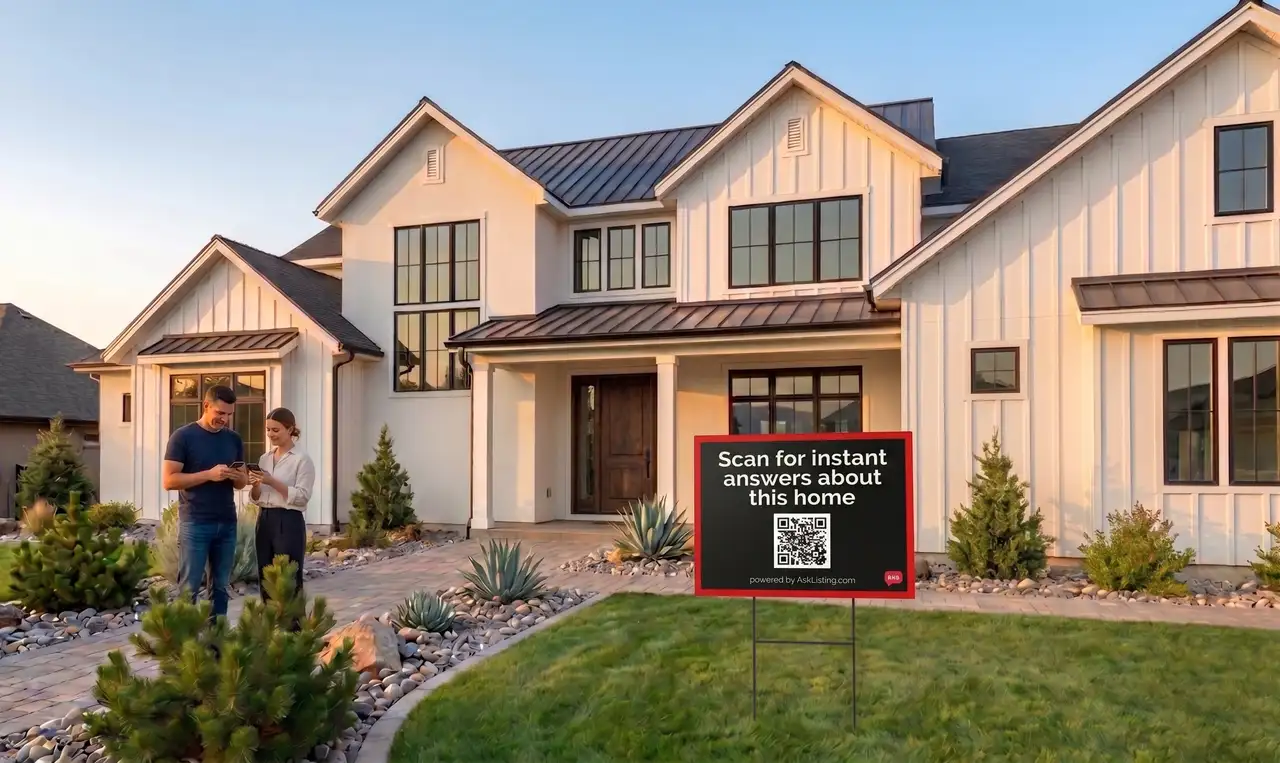
This is a significant blind spot, because the fastest-growing real estate SMS use case runs in the opposite direction. When a buyer scans a QR code on a yard sign, texts a keyword they saw on a sign rider, or clicks "text for info" in an MLS photo, the buyer is the one who reaches out first. The platform receives the message. The platform responds. The agent does not appear in the conversation until the AI escalates a hot lead.
We built the infrastructure that handles those inbound conversations at AskListing. Every text a buyer sends from a listing goes into a conversation thread that the AI manages, grounded entirely on the property's approved information packet. We see what buyers ask when they self-initiate. We see which responses generate follow-up questions and which ones go silent. We know exactly where inbound conversations die and where they convert into scheduled showings.
The scripts in this guide cover both directions. For the outbound templates that most guides already provide well, we will give you the variation-set version, because sending a single identical template to hundreds of leads is now a carrier deliverability risk. For the inbound scripts that no other guide covers, we will give you the logic and the language from the platform side.
Chapter 2: Scripts for When the Buyer Texts First

When a buyer initiates contact, the entire script calculus changes. You are not interrupting. You did not source their number from a list. They came to you, at a specific listing, with a specific question. The TCPA consent question is resolved: they texted you first, which constitutes express written consent for you to respond. What happens next determines whether that buyer turns into a showing or into silence.
The first response is the most important message in the entire thread. It needs to do three things simultaneously: confirm which listing the buyer is asking about (they may have texted three numbers tonight), identify that an AI is responding (not a human agent), and give the buyer a simple, low-friction way to continue the conversation. What it must not do is sound like a generic marketing autoresponder.
Hi, thanks for your interest in [address]. I'm the AI assistant for this listing. What would you like to know: price, beds/baths, HOA details, or something else? Reply anytime.
The menu format ("price, beds/baths, HOA, or something else?") gives the buyer a frictionless first reply. Buyers who answer a menu are significantly more likely to continue the conversation than buyers who face an open-ended "How can I help you?"
[Answer the buyer's question directly from the property packet.]

Anything else you'd like to know before deciding if [address] is worth a closer look?
The closing question ("worth a closer look") softly tests showing intent without asking directly. It surfaces buyers who are serious without pressuring those who are still researching.
Good question. One more thing that might be useful to know: are you currently working with a buyer's agent, or still in the early stages of your search?
This question surfaces representation status, which tells the listing agent everything about the lead's readiness. A buyer without representation is typically less far along in the process. A buyer with representation and a pre-approval letter is a same-week showing candidate.
Would you like to schedule a showing? I can check availability and get something on the calendar for you right now. Just let me know what day and time range works best.
Deploy this after the buyer has asked two or more substantive questions about the listing. Buyers who ask about square footage, then the garage, then the HOA are mentally touring. Move them toward a physical showing before the thread goes cold.
Chapter 3: Why Single Templates Are a Deliverability Risk
Most SMS script guides give you one version of each template. That made sense five years ago. It does not make sense in 2026. Since February 2025, every major US carrier has required A2P 10DLC registration for commercial text messaging, and carrier AI now monitors live message content against the samples you submitted at registration. The problem is not just whether your messages are registered. The problem is whether they match.
When an agent sends the exact same "Hi [name], I saw you were interested in [address]. Is this still a property you would like to see?" message to 400 Zillow leads, carrier AI reads that pattern and treats it the same way a spam filter reads a mass email blast: high volume, identical content, commercial sender. Even if your campaign is registered and your content is compliant, sending undifferentiated templates at scale will eventually degrade your deliverability. The fix is not to abandon scripts. It is to use variation sets: three to five phrasings of the same message intent that differ enough to avoid pattern detection.
Here is what a variation set looks like in practice for an initial outbound lead response:
Hi [name], this is [agent] with [brokerage]. You inquired about [address]. Is this still a home you would like to visit?
Hi [name], [agent] from [brokerage] here. Saw your inquiry on [address] come through. Still looking for something in that area?
[name], thanks for reaching out on [address]. Happy to answer any questions or set up a time to see it. What would be most helpful?
Rotate these across your lead batch. Do not send Variation A to your entire list. Rotate monthly, and update at least one variation every 60 to 90 days to keep the content fresh relative to your registered samples. For the deeper technical explanation of how carrier filtering works and what 10DLC registration actually does, see our guide to 10DLC for real estate agents.
Chapter 4: The Three Messages Your Platform Must Never Send
Every script guide focuses on what to say. This chapter is about what you must never say, specifically in AI-assisted conversations where the platform is responding on the agent's behalf. These are not edge cases. Buyers ask these questions regularly in listing conversations. Getting the response wrong is a compliance liability, not just a service failure.
1. Never Speculate on Price or Seller Flexibility
A buyer in an SMS thread will eventually ask "would the seller take less?" or "is there room on the asking price?" Every real estate platform that runs AI-assisted listing conversations needs a hard script for this moment. The AI does not negotiate. The AI does not speculate. The AI does not hint at flexibility it does not have authority to offer.
Pricing and offer terms are handled directly between the parties and their agents. I'm flagging your interest to [agent name] right now and they'll reach out to discuss next steps. What's the best number to call you on?
This response acknowledges the question, declines to answer it, and immediately escalates to the human agent. It also captures a phone number, which increases the quality of the handoff.
The seller might have some flexibility depending on the offer. It doesn't hurt to come in a little under asking.
Do not send this. An AI speculating on seller flexibility is not authorized to negotiate and creates legal exposure if the seller disputes it.
2. Never Answer Neighborhood Demographics Questions
A buyer asking "what's the neighborhood like?" or "is it a good area for families?" or "what are the schools like?" is asking questions that touch protected class considerations under the Fair Housing Act. An AI answering these questions, even with good intentions, can generate steering language without the agent ever knowing. The correct response is to redirect to objective, publicly available data.
I can point you to some public resources. The school district boundary map is at [district website]. Walk Score for this address is [score]. You're welcome to visit the neighborhood at different times of day to get a feel for it yourself. Anything else about the property I can help with?
This redirects to objective data, does not characterize the neighborhood, and returns the conversation to the property. Walk Score and school district boundaries are factual, publicly available, and fair housing compliant.
3. Never Provide Information Outside the Approved Packet
An AI that answers listing questions must be grounded on the information the seller and agent have approved. If a buyer asks about something not in the property packet (a recent repair, the HOA reserve fund balance, the seller's timeline), the AI must not guess or infer. An ungrounded answer that turns out to be wrong creates trust damage and potential liability.
I don't have that detail in the listing information I have access to. I'm flagging it for [agent name] so they can get you a direct answer. What else can I help with in the meantime?
Chapter 5: The Handoff Script (The Most Valuable Message in the Thread)

The AI-to-agent escalation is the highest-stakes moment in a listing conversation. A buyer who has asked several substantive questions, self-identified as a serious prospect, and expressed showing interest has just become a qualified lead. What happens in the next 30 minutes determines whether that lead results in a showing or gets lost to a competitor who responded faster.
There are two handoff messages that need to be right: what the AI sends to the buyer at the moment of escalation, and what the system sends to the agent.
Great. I'm connecting you with [agent name] now. They will reach out within the hour to discuss scheduling and answer any questions I couldn't. In the meantime, feel free to keep asking me anything about the property.
The phrase "within the hour" sets a specific expectation without over-committing. The offer to continue answering property questions keeps the buyer engaged while they wait, reducing the likelihood they open Zillow and start inquiring on other listings.
Hot lead: [buyer name] texted in on [address] at [time]. Asked about [question summary]. Indicated [showing interest / pre-approval status / timeline]. Full conversation: [link]. Text them at [buyer number] within 30 minutes to book the showing.
The agent alert should include the conversation summary, not just a notification. An agent who reads the summary before responding already knows the buyer's questions and can open with specific context rather than starting from scratch.
The follow-up call or text from the agent should reference the conversation, not restart it. "Hi, this is [agent], I saw you were asking about the HOA situation at [address]" outperforms "Hi, I'm following up on your inquiry" in every dimension. For more on why conversation continuity determines close rates, see our guide on following up with real estate leads by text.
AskListing handles inbound SMS automatically: the AI answers buyer questions from your property packet, qualifies leads, and sends you a handoff alert with the full transcript when a buyer is ready to book. Try it free on your next listing →
Chapter 6: Fair Housing in SMS (The Scripts No One Writes About)
Fair Housing compliance in SMS conversations is almost entirely absent from the script guides that agents use. The TCPA content is thin in most guides, but at least it exists. Fair Housing is invisible. This is a problem, because AI-assisted listing conversations are exactly the context where Fair Housing violations are most likely to occur without the agent ever knowing.
The Fair Housing Act prohibits discrimination based on race, color, national origin, religion, sex, familial status, and disability. In a text conversation, Fair Housing risk appears in two forms: information the AI provides (steering, characterizing neighborhoods), and information the AI withholds or deflects (refusing to provide listing information based on inferred protected class signals).
On the providing side: the neighborhood and schools scripts in Chapter 4 address the most common steering risk. On the withholding side: an AI that provides different quality answers to different buyers based on any demographic signal in their inquiry is potentially violating Fair Housing law. The rule is simple but requires active enforcement in the system design. Every buyer who texts the same keyword gets the same information from the same approved property packet. No variation based on inferred identity. No upselling to more expensive listings. No steering away from the listing.
The practical implementation at AskListing is that the AI engine includes a Fair Housing guardrail that runs before every response. Questions touching protected class territory are deflected to objective data or escalated to the agent. The guardrail fires on a specific set of keyword patterns: school quality, neighborhood demographics, area safety, community character, and proximity language that implies restriction. If you are evaluating AI listing tools, ask specifically about their Fair Housing guardrail. If they do not have one, that is the answer.
Chapter 7: The Complete Script Library
The following templates are organized by stage and channel direction. Outbound templates include variation guidance. Use them as starting points and modify variable elements (listing address, agent name, timing) for every send.
New Lead: Outbound (Agent Initiates After Zillow / MLS Inquiry)
Hi [name], [agent] from [brokerage]. You just inquired about [address]. I'm available right now to answer questions or set up a showing. What's most useful: a quick call, or I can text you the details?
Showing Confirmation
Confirming your showing at [address] tomorrow at [time]. The agent will meet you at the front door. Reply CANCEL if your plans change.
See you at [address] at [time] today. Parking is [detail from packet]. Any last-minute questions before you arrive?
Post-Showing Follow-Up
Hope the showing at [address] went well. Any questions that came up while you were there? Happy to get you answers or talk through next steps.
Price Drop Alert (To Prior Inquiries)
Quick update on [address]: the price just dropped to $[price]. You looked at this one [timeframe] ago. Still interested? Reply YES and I'll get you booked.
Stale Lead Re-Engagement (30-45 Days)
Hi [name], [agent] here. A new listing just hit that matches what you were looking at back in [month]: [brief description]. Want me to send you the details?
Showing No-Show Recovery
Looks like we missed each other at [address] today. No problem. Want to find a time that works better, or has something changed on your end?
Offer Situation Alert (Agent Sends to Warm Lead)
Heads up on [address]: the seller received another offer. I wanted to let you know before it moves forward. If you're still interested, now is the time to talk. Call or text me back.